
Developing the Next Generation of Deployable Telescopes
The image quality of a high-resolution space telescope largely depends on the size of its primary mirror. Under diffraction-limited conditions, the larger the mirror, the better the angular resolution, making it a key consideration in the optomechanical design.
Higher spatial resolution means being able to see finer details, such as cars, buildings and other infrastructure. This is particularly useful for applications such as urban planning and land classification, monitoring global environmental changes and mapping the Earth’s surface for climate and weather studies, as well as surveillance and monitoring for defence and security.
Image quality also depends on the ground sampling distance (GSD), which describes the actual size of the area represented by each pixel on the ground. This is determined by factors such as the detector pixel size and the satellite’s orbital altitude.

Getting high-resolution images from a deployable space telescope requires its mirror segments to be aligned and co-phased with nanometre precision. Traditional approaches rely on point sources (such as distant stars) or extended scenes on the ground.
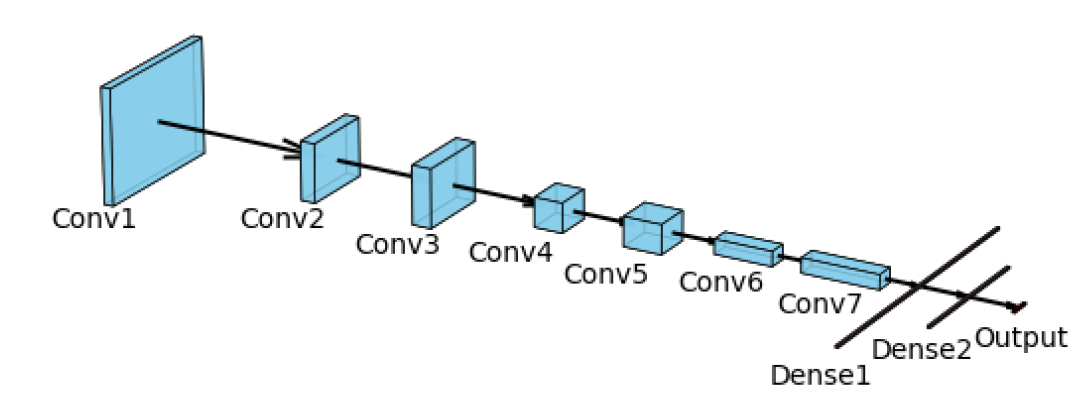
The figure shows the CNN architecture, made up of seven convolutional layers (Conv1–7), two fully connected layers (Dense1–2) and a final output layer. The output can be configured to predict either piston errors only or the full piston, tip and tilt (PTT) errors.
In this project. we have developed a convolutional neural network (CNN )and trained it to analyse point spread functions (PSFs) and retrieve piston errors in just two iterations.
The original approach assumed that the telescope was observing a distant point source (such as a star) or an artificial calibration source on Earth. Here, we take this a step further by introducing IMPACT, an onboard calibration system that allows PSFs to be continuously monitored and the wavefront to be reconstructed, enabling ongoing alignment corrections while the telescope is in operation.
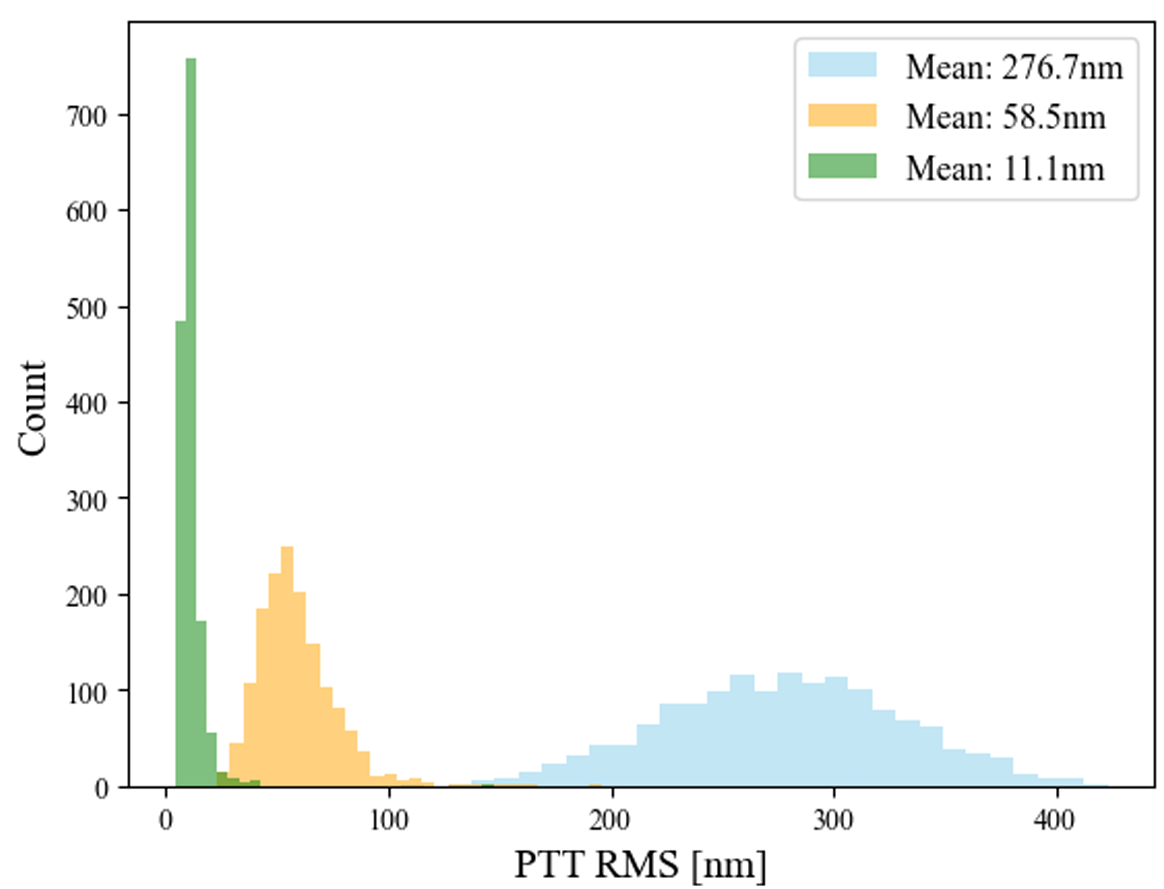
The figure above shows histograms of the RMS PTT (Piston/Tip/Tilt) errors before correction and after each pass. The legend gives the mean RMS error for each dataset.
IMPACT (Image-based Mirror Phasing and Alignment using Convolutional Networks) works by measuring point spread functions (PSFs) on a detector located at the secondary mirror, separate from the main science camera. A deep learning algorithm then retrieves the piston and tip/tilt errors, allowing them to be corrected in real time.
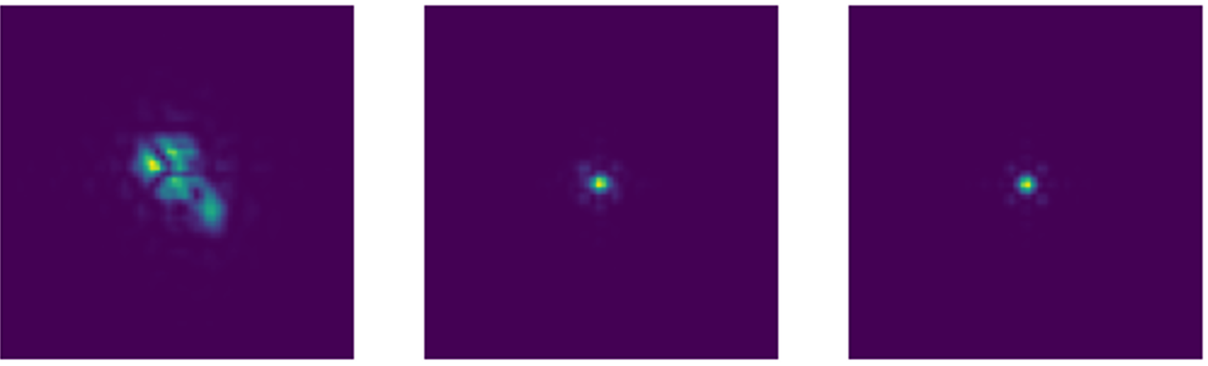
The image above shows a visual representation of PSF images throughout the alignment process. Left image shows the initial aberrated PSF of the full system, with PTT errors present. Middle iamge shows the residual
PSF after the first-pass correction. The right image shows the PSF after the second-pass correction.
more information : https://doi.org/10.3390/aerospace13100905


